If you’re looking to improve your fitness results without spending more hours in the gym, understanding the connection between sleep and muscle recovery is the missing piece. Many people train hard, follow structured programs, and track their nutrition—yet progress stalls because recovery is overlooked.
This article breaks down how quality sleep directly impacts muscle recovery, performance, strength gains, and daily energy levels. You’ll learn why your body rebuilds and repairs tissue most efficiently at night, how poor rest slows progress, and what practical adjustments can help you recover faster between workouts.
Our insights are grounded in established exercise science research and performance-based training principles, combining proven recovery fundamentals with practical fitness strategies you can apply immediately. By the end, you’ll understand how to align your training intensity, recovery habits, and nightly routines so every workout delivers stronger, more consistent results.
The Science: How Sleep Rebuilds You from the Inside Out
First, let’s talk deep sleep—specifically Stage 3/4, also called slow-wave sleep. This is when human growth hormone (HGH) peaks. HGH is the body’s primary repair signal, stimulating tissue regeneration, muscle repair, and bone growth (National Institutes of Health). In other words, if you cut deep sleep short, you cut recovery short.
Next, consider muscle protein synthesis (MPS). MPS is the biological process that turns dietary protein into new muscle tissue. However, research shows sleep restriction significantly reduces MPS rates (Journal of Physiology). So even if your nutrition is perfect, inadequate rest limits progress. That’s why sleep and muscle recovery are inseparable partners.
Meanwhile, sleep also regulates cytokines—proteins that control inflammation. Balanced cytokines reduce excessive inflammation, helping heal exercise-induced micro-tears and lowering chronic pain risk (Harvard Medical School).
Finally, your central nervous system (CNS) only fully resets during sleep. Neurotransmitters like dopamine and serotonin rebalance, improving coordination, reaction time, and gym motivation.
| Function | What Sleep Does | Why It Matters |
|---|---|---|
| HGH Release | Peaks in deep sleep |
Tissue repair |
| MPS Support | Enhances protein use | Muscle growth |
| Inflammation Control | Regulates cytokines | Faster healing |
| CNS Recovery | Restores neurotransmitters | Better performance |
For added recovery support, consider mobility work for desk workers a daily reset plan.
Zlase Fitness Fundamentals: Building Your Nightly Recovery Ritual
If your workouts are the stimulus, your nighttime routine is the repair crew. The most overlooked performance tool isn’t a supplement or smartwatch—it’s consistency.
The Power of Consistency
Your circadian rhythm (your body’s internal 24-hour clock) regulates hormones, energy, and alertness. Going to bed and waking up at the same time every day—even on weekends—anchors that clock. When your schedule constantly shifts, your body experiences what researchers call “social jet lag,” a misalignment between biological and social time (Wittmann et al., 2006).
Some people argue that weekends are for catching up on rest. And yes, extra rest can help in the short term. But regularly shifting your sleep window confuses your internal timing system. Think of it like resetting your phone’s time zone every Friday night (it works, but everything feels slightly off).
Consistency trains your biology. Over time, your brain learns exactly when to release melatonin, the hormone that signals it’s time to wind down.
The Pre-Sleep Hour
A structured wind-down routine removes guesswork.
- 30–60 minutes before bed: No screens. Blue light suppresses melatonin production (Harvard Medical School, 2020).
- Engage in calming activities. Read a physical book, try light stretching, or practice meditation. These lower sympathetic nervous system activity (your “fight or flight” mode).
- Dim the lights. Lower illumination signals your brain to prepare for sleep and muscle recovery.
Pro tip: Keep this routine identical each night. Repetition builds association—when you dim the lights, your body should think, “Ah, it’s that time again.”
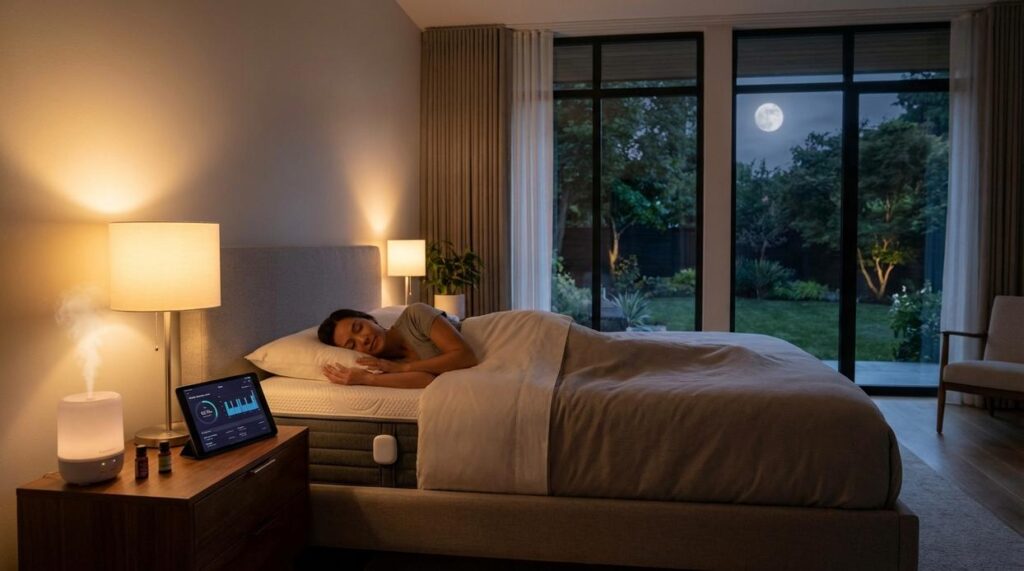
Your Sleep Environment: Engineering the Perfect Recovery Cave

First, keep it cool. Research from the National Sleep Foundation shows the ideal bedroom temperature sits between 60–67°F (15–19°C). Why? Because your core body temperature naturally drops as you fall asleep. A cooler room supports that decline, signaling your brain to release melatonin—the hormone that regulates your sleep-wake cycle. In contrast, overheating disrupts deep sleep stages critical for sleep and muscle recovery (and yes, that late-night thermostat battle matters more than you think).
Equally important, embrace total darkness. Even low light from LEDs can suppress melatonin production, according to Harvard Medical School. Blackout curtains, covered electronics, or a high-quality sleep mask create the cave-like environment your biology expects. Think “Batcave,” but optimized for REM cycles.
Next, master the soundscape. Studies published in Sleep Medicine show consistent white or pink noise can reduce nighttime awakenings by masking sudden environmental sounds. Silence works too—but avoid unpredictable noise spikes that jolt your nervous system.
Finally, reserve your bed for sleep and intimacy only. Behavioral sleep research calls this “stimulus control.” When you scroll or work in bed, your brain forms alert associations. Keep the boundary clear. Pro tip: if you’re awake longer than 20 minutes, reset in low light before returning.
Syncing Sleep with Precision Strength Protocols
Post-Workout Nutrition Timing: Finish your last major meal 2–3 hours before bed so digestion doesn’t compete with recovery. A small, protein-rich casein snack 30 minutes before lights-out can extend overnight MPS, supporting sleep and muscle recovery. Strategic napping matters, too. A 20–30 minute “Momentum Moment” on heavy training days may boost neural output without blunting nighttime rest. Critics argue naps ruin sleep, but short, early-afternoon sessions rarely disrupt circadian rhythm. Implement a caffeine curfew 8–10 hours before bed; caffeine’s half-life can stretch six hours or more, meaning your 4 p.m. espresso still whispers at midnight. Hydration should taper in the final 1–2 hours to prevent wake-ups. Looking ahead, it’s plausible wearable-driven sleep timing will personalize feeding, caffeine, and nap windows with algorithmic precision — a likely evolution, though still speculative. Pro tip: track trends, not single nights. Consistency ultimately compounds physiological adaptation benefits. Daily.
Build Stronger Results Starting Today
You started this guide because you wanted a smarter, more efficient way to improve your performance without wasting time or burning out. Now you understand how intentional training, structured routines, and prioritizing sleep and muscle recovery work together to create measurable progress.
The real frustration isn’t lack of effort — it’s putting in the work and not seeing results. When your workouts lack structure and your body doesn’t fully recover, progress stalls. By applying momentum-driven sessions, precision strength methods, and daily efficiency hacks, you eliminate guesswork and finally train with purpose.
Here’s your next move: commit to a structured weekly plan that balances intensity with proper sleep and muscle recovery, track your performance metrics, and refine your routine consistently. Thousands of driven individuals rely on these proven methods to train smarter, not longer.
If you’re ready to break plateaus and build strength with clarity and confidence, start implementing these strategies today and take control of your results.